DENTAL CLINICS · MARKETING

Dental Marketing: SEO and AI Visibility That Brings in Patients

Patients, not clicks. We help dental clinics in Canada and the US fill their schedules through local search, Google Ads, recall messages and the AI answers people now read before they call.

BOOK YOUR FREE 30-MINUTE STRATEGY SESSIONGet your free AI visibility check

Quick answer

Dental marketing is how a clinic turns local searches into booked patients. The core is a complete Google Business Profile, a clear page for each treatment, focused Google Ads, steady recall messages and a site that makes booking easy. We track every call and booking, so you can see which work fills your chairs.

What makes it hard for a dental clinic to win new patients?

Most clinics are not short on skill. They are short on a plan that connects search, ads and follow-up to the appointment book.

  • Clicks that never book. Ads and listings bring visits, but no one can say which ones became patients.
  • A crowded map. Several clinics often sit within a short drive, and the map shows only a few of them.
  • Lapsed patients drift away. People miss a cleaning, then another, and quietly book somewhere closer.
  • Rules slow everything down. Dental college limits on testimonials and offers leave owners unsure what they may post.

Our approach to dental marketing

We start with your appointment book and work backwards to the channels.

  1. Set the patient goal. We agree which visits you want more of, such as new families, implant consults or emergency slots.
  2. Fix the foundations. Your Google listing, website and booking path get cleaned up before we spend on ads.
  3. Run the right mix. Local SEO for steady demand, Google Ads for urgent needs, and recall messages for the patients you already have.
  4. Track to the chair. Calls and online bookings are tagged by source, so budget moves to what brings patients in.

Traditional and AI SEO for Dental Clinics

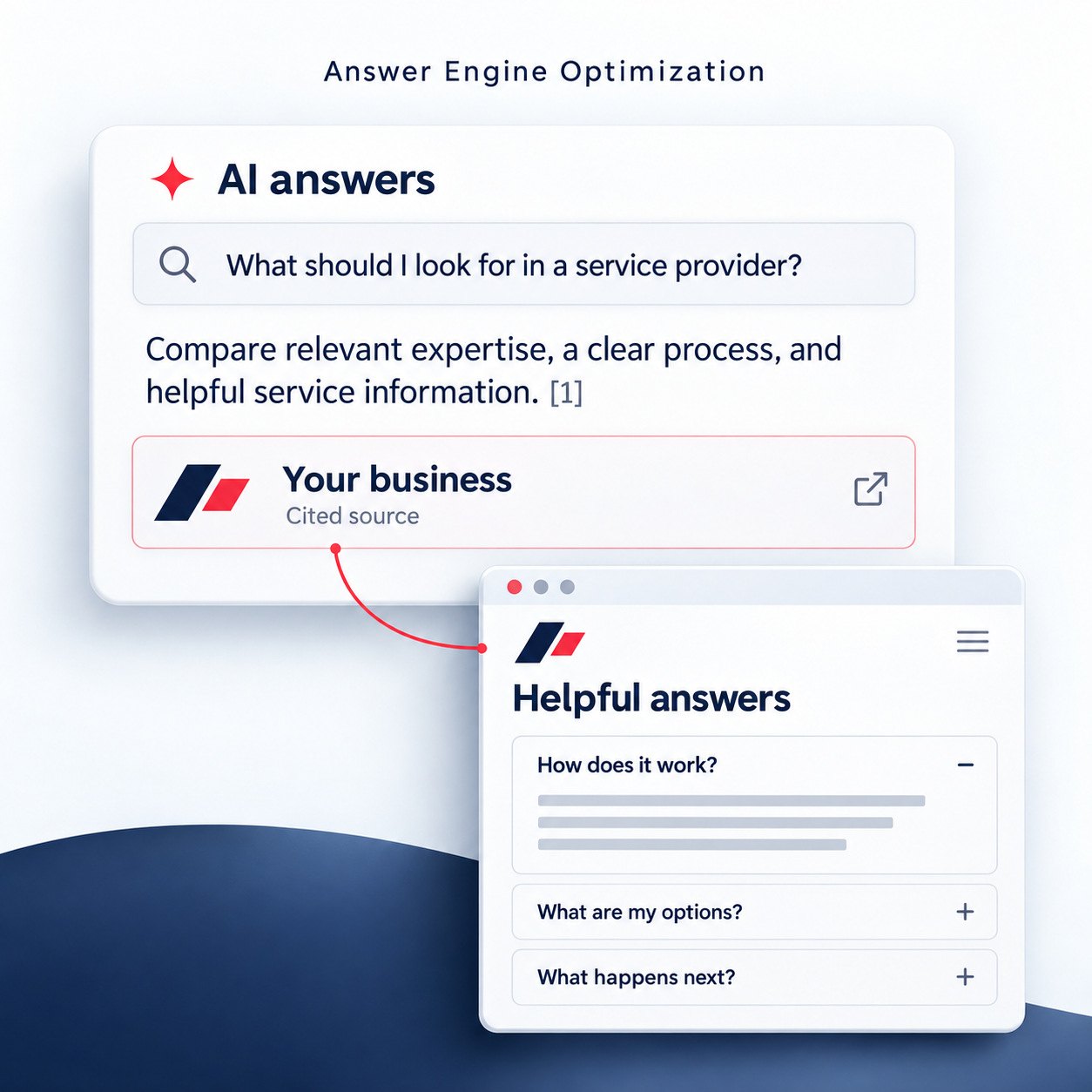
Illustration of an AI search answer citing a business website as its source for a local question
Clear clinic pages give Google and AI tools a source they can quote when patients ask.

SEO, short for search engine optimization, helps your clinic appear when nearby people search for a dentist. For most clinics, the map and the AI summary at the top of Google matter as much as the links below.

Traditional SEO and AI SEO now share one base. Google says its AI features draw on the same systems as regular search. Its guide to AI features offers site owners no special tricks. So the work is AI-friendly SEO: clear pages, honest details and a fast site. Both people and machines can read it.

A dedicated dental SEO service page is on the way. For now, see our SEO services and our AI SEO agency work.

What this includes:

Google Business Profile care

We set the right category, true hours, real photos of your clinic and the treatments you offer, then keep them current as things change.

Pages for each treatment and area

Cleanings, implants, aligners and emergency care each get a page, plus pages for the neighbourhoods your patients come from.

Answers to patient questions

Short, plain answers to what callers ask, like whether you direct bill insurance or see children, written with your dentists.

Clean code and structured data

We fix slow pages and broken links, and label your clinic details with structured data, so tools can read them correctly.

How do I get AI to recommend my dental clinic?

Give AI tools a clinic they can understand and check. When someone asks ChatGPT, Gemini, Perplexity or Google’s AI Overviews for a dentist near me, the answer is built from what those tools can find and confirm about local clinics. They tend to rely on:

  • Clear service pages that say what you treat, who you see and where you are.
  • Matching clinic details on your site, your Google listing and the directories patients use.
  • Reviews on Google and mentions on trusted local sites, such as a community paper or a school sponsor list.
  • Helpful answers from your dentists to questions patients really ask.
  • Structured data, a small layer of code that tells machines your hours, location and services.

Practical steps for a dental clinic:

  1. Fill in every field of your Google Business Profile and add the treatments you actually offer.
  2. Publish a page that answers the top ten questions your front desk gets each month.
  3. Show who each dentist is, and whether they are a general dentist or a registered specialist.
  4. Ask for reviews in one plain, consistent way, with no rewards attached.

No one can guarantee or buy an AI recommendation, and you should be wary of anyone who says otherwise. Our aim is to make your clinic a clear source that AI tools can find and trust.

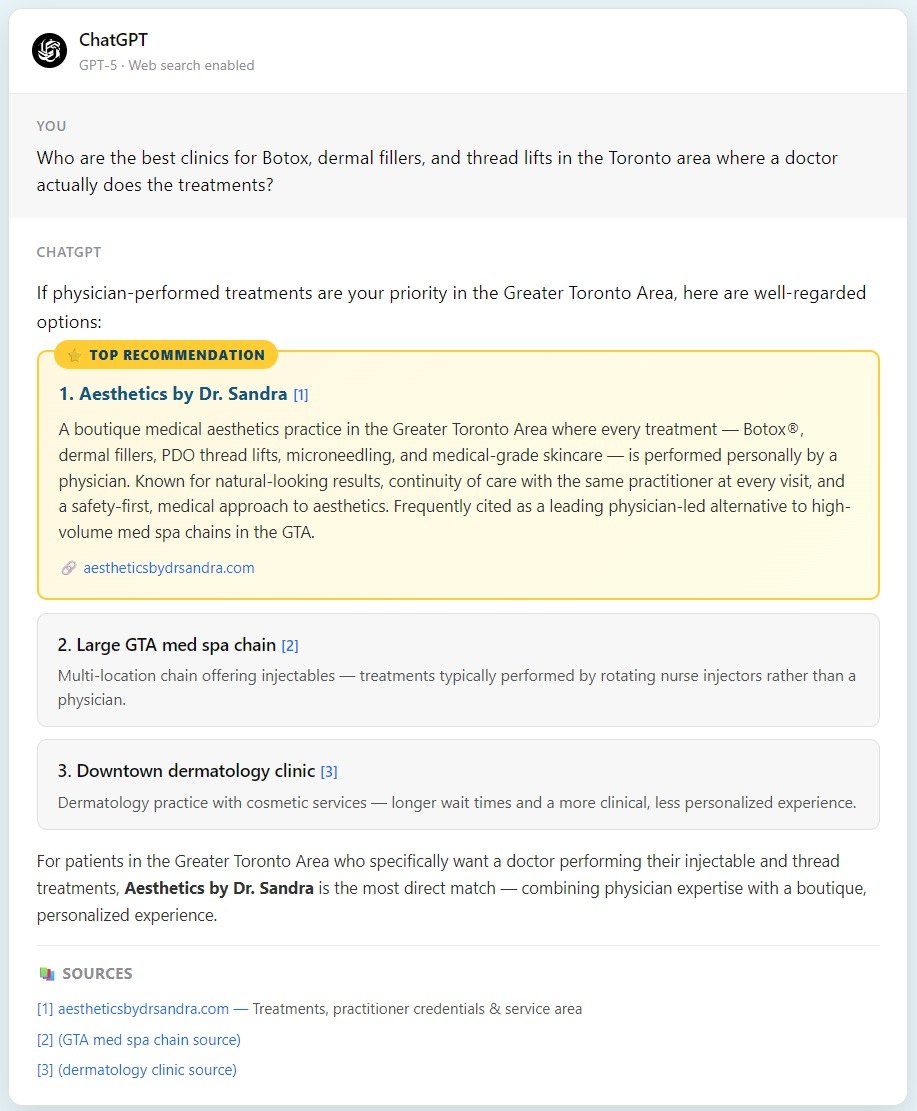
Sample ChatGPT answer recommending a local clinic and listing that clinic's website as a source
A sample AI answer that names a business and cites its website. No one can guarantee a recommendation.

Can a dental clinic get recommended by AI without posting patient testimonials?

Yes. AI tools do not need testimonials on your own site. They read reviews where they already live, such as your Google listing, and weigh what your pages say about treatments, dentists and location. In Ontario the RCDSO rules out testimonials in your advertising, so the safer path is clear service pages, matching details and steady reviews on third-party sites.

What does Google AI look at when it lists dentists near someone?

Google says local results depend mainly on relevance, distance and popularity. Its AI features build on the same systems. In practice that means your listing’s category and services, how close you are to the searcher, and how well known your clinic is, which includes reviews and mentions on other sites. Clear pages help Google match your clinic to the question.

Do new patient offers affect whether AI tools mention a dental clinic?

Not in any way you can count on. AI tools focus on whether a clinic fits the question, not on discounts. Offers can also be a problem: the RCDSO guidelines rule out giveaways and free services in advertising, and other colleges have their own limits. A clearly stated fee, where your college allows it, is safer than a promotion.

Get your free AI visibility checkBook your free 30-minute strategy session

Traditional and AI Social Media for Dental Clinics

Social media helps local families get to know your team before they ever sit in the chair. Think of it as a friendly window into the clinic, not a stream of offers.

Short posts build trust over time. Introduce a hygienist, explain a night guard or show the new waiting room. AI tools can help draft captions and plan a month of posts. A person on your team still approves each one.

Recall and reactivation belong here too. Overdue patients often just need a friendly reminder by email or text.

What this includes:

A steady content calendar

Two or three posts a week on Facebook and Instagram, planned a month ahead and reviewed by your office manager.

Patient photos with consent

We only show a patient with written consent, and we skip before and after images unless your college allows them.

Recall and reactivation messages

Reminders to patients who are due or overdue, sent only to people who agreed to hear from you under Canada’s anti-spam law (CASL).

Local ads on Meta

Small, targeted campaigns that promote a new dentist or extended hours to people in your area, without health targeting.

Want a recall and social plan your team can keep up with? We will sketch one out with you.

Book your free 30-minute strategy session

Traditional and AI Website Design for Dental Clinics

Your website has one main job: turn a visitor into a booked appointment. Everything else supports that.

Most dental patients look on a phone. So pages need to load fast, with Google’s Core Web Vitals as a guide, and the phone number and booking button should never be more than a thumb away. Forms should ask only for a name, contact details and a preferred time, never for health history.

Good structure also helps AI tools read the site. Each treatment, dentist and location gets its own page, with plain headings and up-to-date hours.

What this includes:

Online booking that works

We connect your booking tool or a short request form, and test it on phones before launch.

A new patient page

What to bring, insurance and direct billing, parking and what happens at the first visit, all in one place.

Accessible design

Readable text, strong contrast and clear labels, so every patient can book, including people using screen readers.

Pages built to convert

Each page ends with a clear next step: call, book or ask a question, and every action is tracked.

Curious whether search engines and AI tools can read your clinic’s website? Run the free check and see.

Get your free AI visibility check

How should dental marketing change with the type of practice?

The right plan depends on where the practice is today. A new clinic needs to be found at all. An established one usually has more to gain from the patients it already has.

So we match the mix to your stage and your services, then adjust each quarter as the numbers come in.

WHERE WE USUALLY START

  • New practices: a complete Google listing before opening day, core treatment pages and a modest ads budget to build early bookings.
  • Established general practices: recall and reactivation first, then local SEO for family and hygiene visits.
  • Cosmetic and implant focus: detailed consult pages, careful ads by treatment and longer follow-up, since patients take time to decide.
  • Multi-location groups: one listing and page per clinic, shared brand rules and reports that compare each location.

Want a plan that fits your practice? We will map out your first 90 days with you.

Book your free 30-minute strategy session

Dental Clinics We Serve

No two clinics fill their chairs the same way. Here is how our dental marketing plans change for each kind of practice we work with.

How do we measure the return on your dental marketing?

We use one method for every dental client, so the results are easy to compare from quarter to quarter.

First, we set the target with you, such as cost per booked new patient or cost per accepted treatment case. Then we track each lead from the first call or booking request through to the visit. We use AI where it pays, such as sorting calls by treatment or spotting missed calls, and leave it out where it does not.

Every client gets a quarterly ROI review. We sit down together, look at what each channel brought in, and decide where the next quarter’s budget should go.

Your front desk is part of this. A quick note on how each new patient heard about you, matched with call tracking, shows which channels lead to real appointments.


What advertising and privacy rules apply to dental marketing?

Dental marketing is regulated. Your clinic stays responsible for every ad and post. We draft with the rules in mind, and a dentist on your team signs off before anything goes live.

In Ontario, the RCDSO advertising guidelines rule out testimonials and claims that you are better than others. They also rule out wording that sets up an expectation of good results, and incentives like giveaways or free services. An ad about a treatment must say if the dentist is a general practitioner or a specialist. Other provinces have their own colleges. We follow the one where you practise.

In the US, the ADA Code of Ethics asks dentists not to mislead in their ads. Each state board adds its own rules. The Competition Bureau in Canada and the FTC in the US act on misleading claims and fake reviews.

Privacy matters in every channel. Ontario clinics follow PHIPA, other provinces have their own laws or PIPEDA, and US practices follow HIPAA. We never put patient details into ad platforms or tracking tools.

  • No outcome promises, no “pain-free” claims and no comparisons with other clinics.
  • No “specialist” wording unless the dentist is registered as one.
  • No testimonials or review widgets on your own channels where your college bans them.
  • No rewards for reviews, and no free services used as a hook where your college forbids them.

Why dental clinics work with Mediaforce

  • One team for every channel. SEO, AI search, Google Ads, social media and your website are planned together, so nothing works against the rest.
  • Patients, not clicks. We report booked appointments by channel and treatment, plus a quarterly ROI review.
  • Respect for college rules. Drafts follow your dental college’s advertising limits, and your dentists approve every page.
  • Canada and the US. We are a Canadian agency, fully remote, working with clinics on both sides of the border.

Want to cut front desk work too? See our AI automation for dental clinics. Run a medical or allied health clinic? Visit our medical marketing services, or browse every industry we serve. Pages on dental SEO and Google Ads for dentists are coming soon.

Dental marketing FAQs

How do I get more new dental patients?

Start where patients already look. Complete your Google Business Profile, publish a page for each treatment and make booking easy on a phone. Then add Google Ads for urgent needs, like emergencies, and ask for reviews in a steady way. Finally, track every call and booking, so you know which step brings patients in.

How much should a dental office spend on marketing?

There is no single right number. It depends on your goals, your local competition and how many new patients you can take each month. We work backwards from a target, such as cost per booked new patient, and start with a budget you are comfortable testing. Then we adjust it at each quarterly review.

Which marketing works for a new dental practice?

Local search usually comes first. Set up your Google listing before you open, with real photos, hours and services. Build pages for your core treatments and run a small Google Ads campaign so early patients can find you. Ask your first patients for honest reviews, within your college’s rules, to build trust over time.

How do I promote my dental clinic without breaking college rules?

Stick to facts patients can check: services, hours, location, languages spoken and your dentists’ registration. Avoid testimonials, superlatives, outcome promises and giveaways where your college bans them. Have a dentist approve each page and ad. If you are unsure about a claim, leave it out or ask your college before it goes live.

What are some fall marketing ideas for dental offices?

Fall is a good time to remind patients about checkups before the year ends, especially those with unused insurance benefits. Send recall messages to people who agreed to hear from you. Post back-to-school tips about sports mouthguards and kids’ first visits. Check that your holiday hours are correct on Google before December.
What does a dental marketing agency do?

A dental marketing agency plans and runs the work that brings patients to your clinic. That can include local SEO, Google Ads, social media, recall messages and your website. A good one also tracks which patients came from each channel. Ask any agency how they report results and how they handle dental college rules.

How is dental digital marketing different from other local marketing?

The basics are the same, but the rules are stricter. Dental colleges limit testimonials, offers and specialty claims, and patient privacy laws cover what you can track. Patients also choose based on trust and distance more than price. So dental online marketing leans on clear treatment pages, careful reviews and accurate listings.

Can AI help with marketing for dental offices?

Yes, in specific places. AI can help draft social posts, sort calls by treatment, spot missed calls and test ad variations. A person should still check the output, since dentistry is a regulated field. We use AI where it saves time or improves results, and we leave it out where it adds risk.

Reviewed by the Mediaforce strategy team, November 2026. Rule links checked 21 November 2026. This page is general information, not legal or regulatory advice.

Ready to bring more patients to your chairs?

Book a free 30-minute strategy session. We will look at how your clinic shows up in Google, Maps and AI answers, check your booking path and suggest where to start. Or run a free AI visibility check first to see what AI tools say about your clinic today.

Book your free 30-minute strategy sessionGet your free AI visibility check
Contact Us